Q1 is more than a budget reset. It offers a rare window to stop reacting to problems and start planning for growth. Most businesses enter the year carrying “accidental” IT. This occurs when tools are added under pressure or temporary workarounds become permanent. Over time, these choices create invisible costs and security risks.
The data supports this concern. According to the Flexera 2025 State of ITAM Report, the percentage of organizations with full visibility into their technology stacks dropped to just 43% this past year. As these blind spots grow, so does wasted spending.
A Q1 IT stack assessment is not about replacing every system. Instead, it provides the clarity you need to reduce friction and spend more efficiently. From an advisory perspective, this is the ideal time to evaluate your managed IT services strategy. By auditing your current environment now, you can ensure your service providers are aligned with your 2026 goals.
What an IT Stack Really Looks Like After a Few Years of Growth
Most IT stacks take shape through practical decisions made at different points in the business. Each one solves a real problem at the time. Over a few years, those choices create patterns that are easy to overlook when you focus only on day-to-day operations.
Different Standards Across Locations
As your footprint grows, locations often end up with different setups based on timing, local availability, or past relationships. One site may run on a newer setup while another relies on older services that still function but no longer align. These differences seem minor until you try to support them consistently or compare performance across sites.
Overlapping Tools with Unclear Ownership
It is common to see tools added to address specific needs without a clear plan for long-term ownership. Over time, similar services start to overlap. No one feels fully responsible for these tools, which makes decisions about changes or renewals harder than they need to be.
Contracts that Drive Decisions instead of Strategy
Renewal dates rarely line up. Some agreements renew annually, others span multiple years, and terms vary widely. As a result, decisions often happen based on timing rather than fit. This approach limits your ability to step back and choose what supports your business best.
Limited Shared Understanding of the Full Environment
Key details often live in separate systems, email threads, or individual memory. When knowledge stays fragmented, it becomes difficult for leadership to get clear answers. Simple questions take longer to resolve because no single view of the stack exists.
For multi-location businesses, these patterns create more than technical complexity. They slow down support, increase cost over time, and make planning harder than it should be. An IT stack assessment brings these details into focus. You see the environment as it actually operates today, which gives you the clarity needed before making any changes.
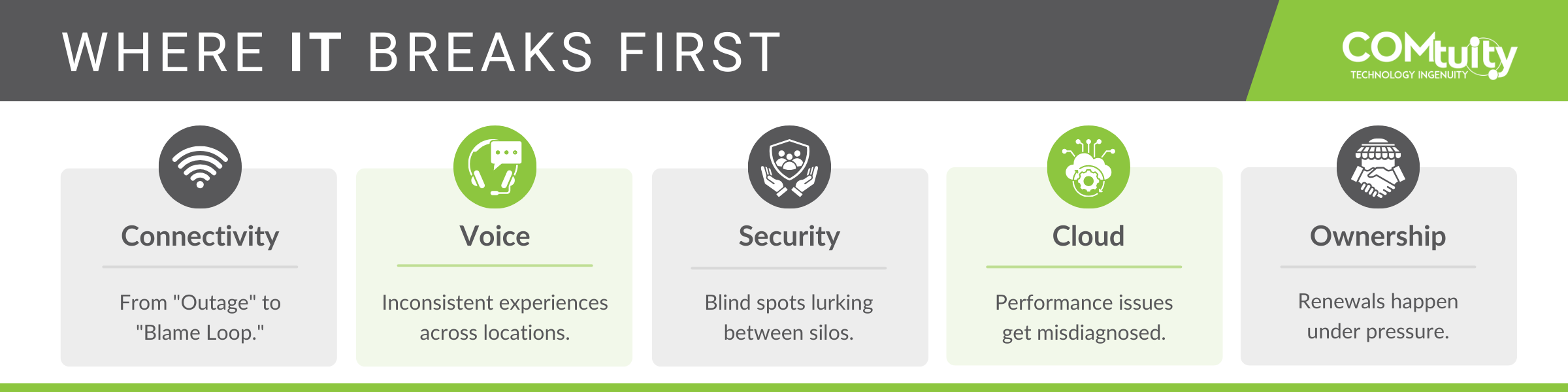
The Q1 Advantage: Resetting Your IT Baseline
Timing shapes outcomes. In Q1, you control the pace because budgets are fresh and renewals are months, not weeks, away. This window provides the leverage to move from reactive fixes to strategic planning.
A Q1 assessment replaces assumptions with a factual baseline, answering four critical questions:
- Core Support: What systems actually drive business functions today?
- Ownership: Which teams or partners are responsible for each platform?
- Consistency: How uniform are tools and services across all locations?
- Vendor Value: Which relationships deliver steady value versus ongoing friction?
By establishing this “single version of the truth,” leadership, finance, and IT can align on a shared context. This ensures that every decision made in 2026 is driven by long-term business goals rather than short-term technical debt.
Clarity Over Change: What a Smart Assessment Focuses On
A common misconception is that an IT stack assessment always leads to a mass replacement of tools. In reality, the most valuable outcome is often the clarity to know what should stay.
A smart assessment identifies the systems that are already performing well and supporting your business goals. It surfaces the areas where you simply need better documentation or clearer ownership rather than new technology.
Standardization does not mean forcing every location into the same mold. It means setting clear guidelines that support growth while leaving room for local needs. When these standards exist, your team spends less time debating options and more time executing plans.
This clarity builds confidence. You move into the rest of the year knowing which decisions matter most and which ones can wait.
Where Managed IT Services and Vendor Consolidation Fit
Managed IT services deliver the most value when they operate within a structured framework. Without a clear understanding of your IT stack, you often end up with overlapping tools and undefined responsibilities that limit the impact of external support. A Q1 assessment helps you define which functions should remain internal and which ones are better suited for a specialized partner.
From an advisory lens, vendor consolidation is a strategic way to simplify this environment without losing capability. Practical improvements from this approach include:
- Strategic Alignment of External Services: Vendors should complement your internal team rather than adding complexity. A clear stack assessment allows you to assign specific responsibilities to the right partners, freeing your staff to focus on high-impact projects.
- Defined Accountability: Responsibilities are clearly assigned across all systems. This reduces delays and ensures that everyone understands who owns a task during daily operations or troubleshooting.
- Reduced Vendor Sprawl: Consolidation makes it easier to see where providers overlap. You can reduce the number of contracts across connectivity, cloud, and security while maintaining the flexibility your business needs.
- Predictable Financial Planning: Dealing with fewer vendors simplifies your administrative overhead. It streamlines invoicing and renewals, which leads to more reliable budgeting and greater confidence in your long-term costs.
With a clarified IT stack, managed IT services and vendor consolidation work together to reduce operational noise. This ensures your technology supports your business objectives rather than creating new friction.

How COMtuity Supports Your IT Stack Alignment
When an IT environment grows across multiple locations, keeping systems and vendors aligned can be overwhelming. COMtuity helps you regain control by providing structure across your technology stack. As a strategic advisor, we focus on both immediate efficiency and long-term scalability.
Benefits of the COMtuity advisory model include:
Strategic Lifecycle Oversight: We provide an end-to-end audit of your technology environment, including connectivity, cloud services, and cybersecurity. This identifies hidden inefficiencies and ensures your systems support your operational goals.
Unbiased Vendor Selection: With access to over 800 suppliers, we help you consolidate vendors without sacrificing quality. We identify the best fit for your specific needs and handle the heavy lifting of contract negotiation and process standardization.
Cross-Location Architecture: We help you establish technology standards that allow your teams to execute consistently across every site. This reduces the friction of onboarding new locations and ensures day-to-day operations run smoothly.
Cost Transparency: Through careful audits and lifecycle management, COMtuity often uncovers up to 30% in potential savings. You gain clear insight into your expenditures and achieve more predictable budgeting.
Executive Advocacy: Our white-glove approach provides your team with a high-level escalation point. We manage the vendor relationships so your internal staff can focus on strategic initiatives rather than troubleshooting service providers.
By combining deep market insight with ongoing oversight, COMtuity ensures your technology decisions are deliberate, and your vendors remain accountable. This structured approach reduces risk and allows your technology to actively support your business objectives.
Strategic Control for the Year Ahead
You do not have to navigate the complexities of vendor management or technology audits alone. A Q1 assessment is the first step toward a more manageable and scalable environment that supports your team instead of slowing them down. With a clear view of your stack and a strategic advisory partner to manage the details, you can return your focus to your core business goals. Connect with us to explore how a tailored assessment can simplify your technology strategy for 2026.