As tech advisors, we see how poor IT infrastructure can shape systems, collaboration, and decision-making. When an IT framework isn’t designed with intention, responsibilities are siloed, creating friction across teams and across your organization.
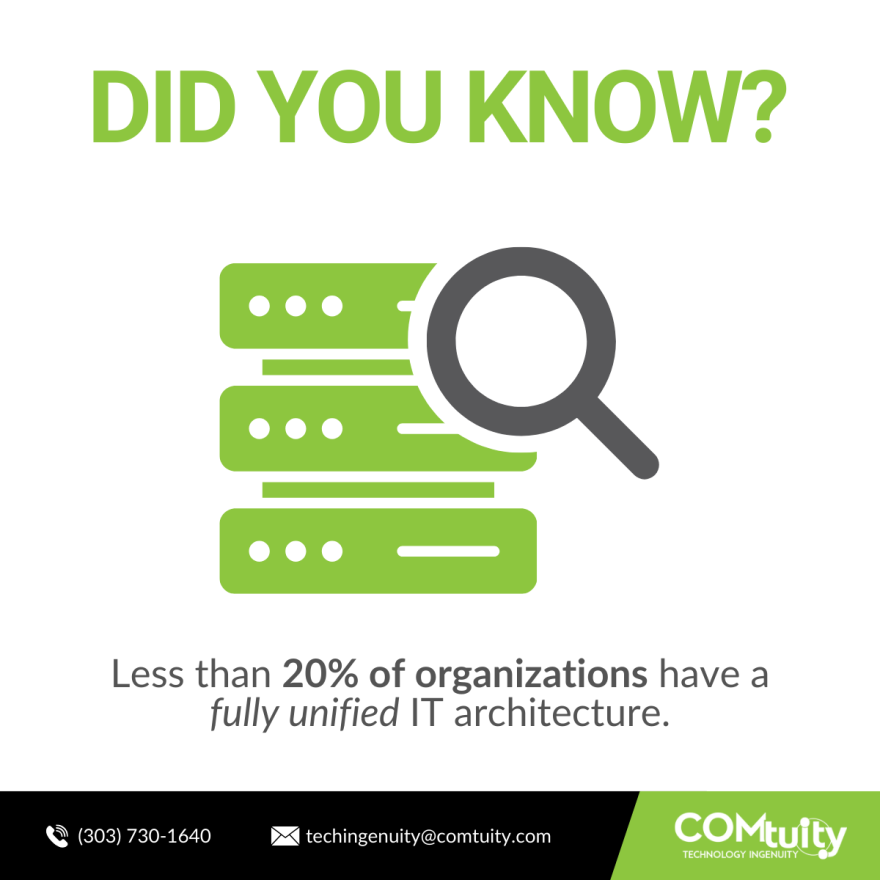
A unified, strategic IT architecture changes that. It creates a shared blueprint for how technology and teams should operate together. Strategic IT aligns infrastructure, security, and access with business goals. Doing so provides internal IT teams with a clear structure to operate within.
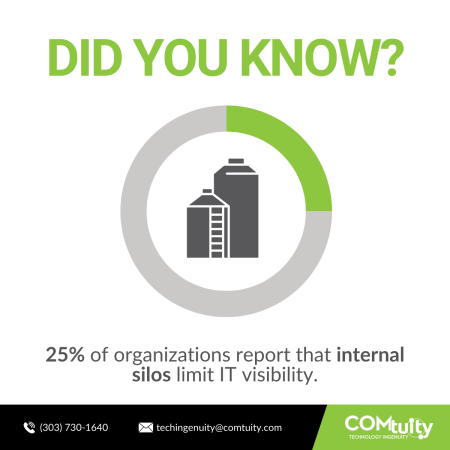
Without it, operational silos form. Those silos create tension between teams and slow down response, collaboration, and progress.
 The Operational Cost of Disconnected IT Silos
Most organizations feel the strain of IT silos long before they can clearly name the problem. It shows up in several ways:
- Tickets bounce between teams.
- Meetings stall over ownership questions.
- One group pushes for speed while another pushes for control.
At the center of this tension sit two critical functions: the Network Operations Center, or NOC, and the Security Operations Center, or SOC.
When Performance and Security Compete
The NOC focuses on uptime, speed, and reliability. Its goal is to keep systems available so employees and customers can do their jobs. The SOC focuses on risk, threats, and protection. Its job is to reduce exposure and prevent incidents that could damage the business. When these teams operate in silos, conflict is inevitable. Teams duplicate work, troubleshoot the same issues in different systems, and respond to incidents without a shared view of what is happening. Even small changes take longer because no one wants to be responsible for breaking something else.
The Hidden Cost of Tool Sprawl
Disconnected silos also drive technology consolidation challenges. Many organizations pay for tools they barely use. This is why our Strategic TBR is so vital. A full audit finds the waste before it can get the best of your business. Without a single source of truth and a strategic IT architecture, it’s hard to see what is essential and what is simply inherited. Licensing fees add up. Support contracts renew automatically. Training new staff becomes harder because every environment looks different.
Don’t think this disconnect stays contained within IT, either. At COMtuity, we see firsthand how outdated IT environments affect the business’s overall operations.
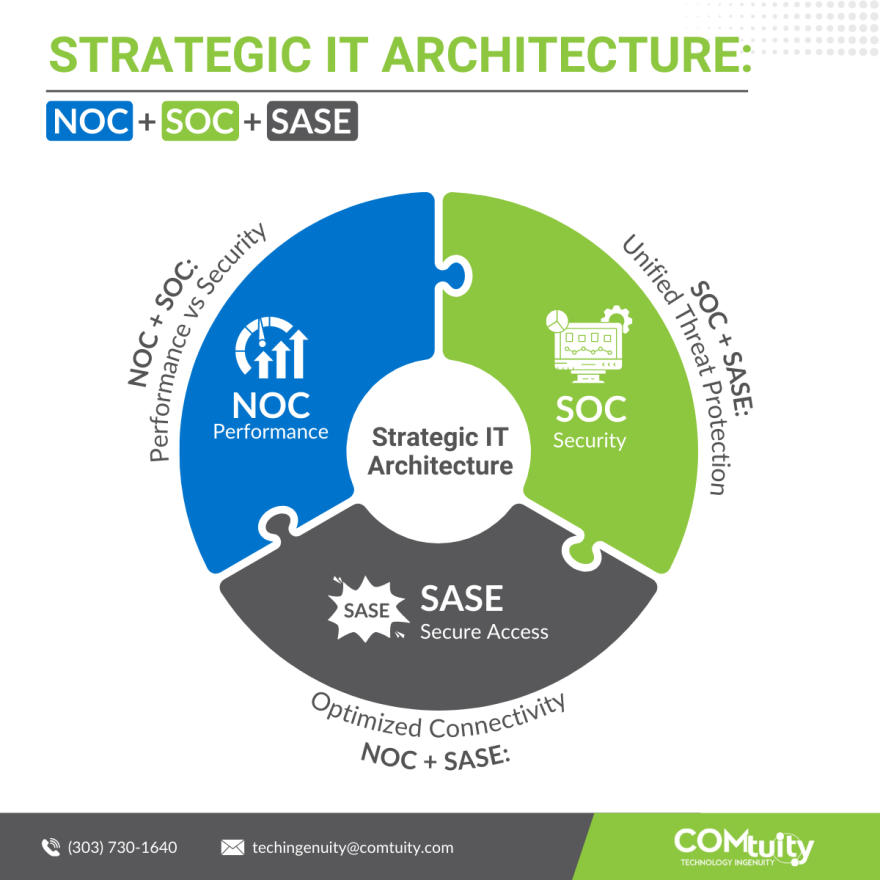
Strategic IT brings structure back into the picture. It doesn’t start with tools. It starts with alignment. So, what does this alignment look like in practice? It centers on a symbiotic relationship between three core functions: the NOC, the SOC, and SASE.
The Trinity of IT: NOC, SOC, and SASE
At its core, strategic IT treats networking, security, and access as parts of the same system. Instead of layering solutions on top of each other, it designs how those functions work together.
Modern environments benefit when the NOC and SOC stop acting as separate worlds. Convergence allows performance and security to support each other instead of competing.
Secure Access Service Edge, or SASE, plays a key role here. Rather than forcing traffic through fixed points or separate security layers, SASE brings networking and security together at the edge. Users get access based on identity and context. Traffic gets inspected without unnecessary detours.
When NOC, SOC, and SASE operate as a cohesive unit, the conversation around IT shifts. It moves from managing complex infrastructure to making security a true business enabler.
Making Security a Business Enabler
Security often gets framed as a blocker because it is introduced late or layered on top of existing systems. In a strategic architecture, security becomes an integral part of the design. SOC capabilities integrate directly with network operations. Policies apply consistently across users and locations. Visibility improves, which reduces both risk and noise.
The benefit is simple. Fewer incidents, clearer accountability, and confidence that protection does not come at the cost of performance. Designing these pieces to fit together is the hallmark of a mature organization. To move from a ‘random tech stack’ to this intentional architecture, you need a partner focused on building your future with objective guidance.
Building Your Future with Objective Guidance
Technology should not feel like a constant compromise between speed and safety. When systems grow without design, that compromise becomes the norm.
A Strategic IT Architecture changes that dynamic. By aligning NOC, SOC, and SASE, organizations replace silos with shared outcomes.
The shift starts with clarity. Understanding what you have, how it is used, and what it costs creates room to make better decisions. A Strategic TBR provides that clarity and turns hidden waste into an opportunity to fund smarter design.
COMtuity brings an objective perspective to this process. As a vendor-agnostic tech advisor, the focus stays on what serves your business, not what sells a product. The result is a data-driven roadmap that replaces a random tech stack with intentional architecture.
If you need help crafting a united, strategic IT architecture for your business, contact COMtuity today! Let’s review your IT environment options together.