
At some point, the vendor relationship just feels different.
You cannot always point to the exact moment it changed. The contract is still in place. The logo on the invoice might even be the same. But the responsiveness is gone. The person who used to pick up on the second ring has been replaced by a ticketing portal. Escalations that used to take a phone call now take three days and a case number. The relationship that once felt like a partnership now feels like an account.
This shift rarely shows up overnight. It usually follows a merger, an acquisition, or a quiet restructuring inside the provider’s organization. From the outside, nothing looks broken.
We have walked into this situation more times than we can count. It is one of the most common operational frustrations we hear from leadership teams, and it is almost always misread as a customer service issue when it is actually something deeper.
Vendor Consolidation Changes More Than the Logo
The technology channel has been in a long stretch of consolidation. Telecom carriers acquire smaller carriers. Managed service providers get rolled up by private equity. Cloud platforms absorb adjacent tools. Security vendors merge to expand their portfolios.
On paper, this looks like progress, but in practice, the experience often goes in the opposite direction for the customer.
When vendor consolidation happens, the company you signed with is not really the company supporting you anymore. The brand might still appear on your bill, but the people, processes, and priorities behind it have shifted. The flexibility that was built into your original agreement gets standardized away because the new parent company has thousands of accounts to serve.
This is not a customer service failure. It is a structural reality. The vendor’s center of gravity has moved, and your account moved with it, whether you signed up for that or not.

How Businesses Quietly Lose Leverage
Leverage is one of those things you do not notice until it is gone.
Before the acquisition, you probably had someone on the inside who knew your environment. They knew which sites had unusual configurations. They knew which contracts were up for renewal. They knew which issues to take seriously and which ones could wait. That institutional knowledge meant your problems got solved faster because someone already understood the context.
After the acquisition, that knowledge often walks out the door. The replacement is a larger support organization that treats your account as one of thousands. The urgency you used to take for granted becomes something you have to fight for. You did not suddenly become less important to your business. You just became one of many inside theirs.
The hardest part is that this loss of leverage is rarely visible in the first few months. It shows up slowly. A ticket that used to be resolved in an hour now takes a day. A change request that used to require one email now requires three. Each instance feels minor. Together, they represent a meaningful drop in operational efficiency.
This is where a strong vendor management strategy becomes the difference between an environment that absorbs these changes and one that gets quietly buried by them.
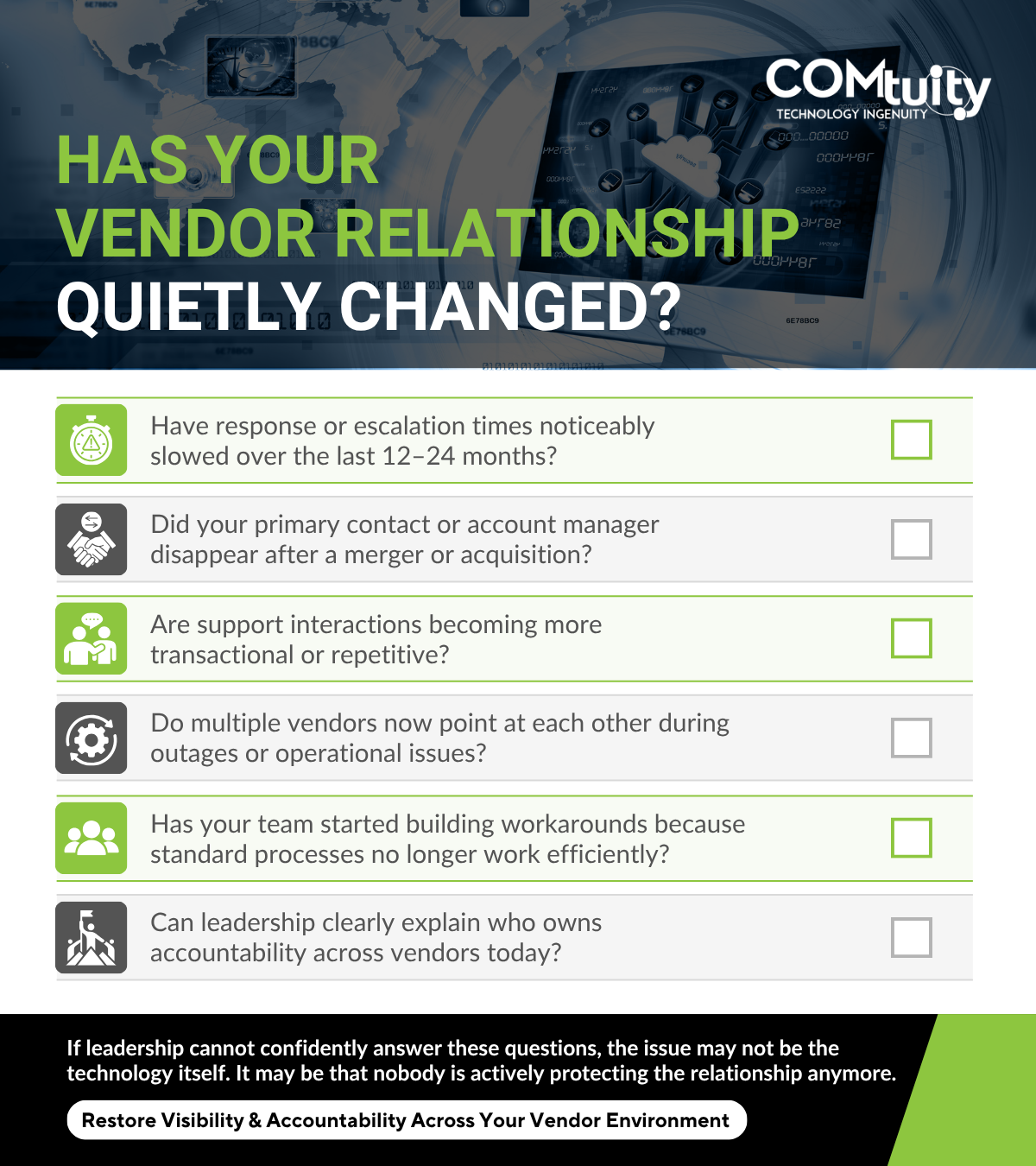
What Strategy Drift Looks Like Operationally
The clearest way to understand this is through moments that feel painfully familiar.
The three-way troubleshooting call. A point of sale system goes down during lunch rush. The network provider says it is a hardware issue. The hardware vendor says it is the network. Your IT lead ends up mediating a three-way call while the location runs transactions on a backup tablet.
Before the acquisition, someone at the provider would have stepped in and pushed for a resolution. After the acquisition, that person is gone.
The slow drift in deployment standards. Every new site was supposed to follow the same model. Then real life happened:
- Site 23 needed to open quickly, so a different internet provider was used.
- Site 31 had a landlord restriction, so a workaround was built.
- Site 38 inherited the previous tenant’s infrastructure to save time.
Three years later, the IT director cannot confidently explain how those sites are configured because everyone has their own story.
None of these exceptions were unreasonable on their own. But without someone protecting the broader plan, exceptions become the new normal and the original standard quietly disappears.
This is the cost of not having a strategic layer that survives changes inside your provider’s organization. We have written more about this dynamic in the context of carrier mergers specifically.

Where COMtuity Fits In
We are not here to replace your vendors. We are here to make sure your interests stay protected as those vendors change.
Think of us as the relationship quarterback. We sit between your business and your providers, coordinating across them and stepping in when escalations stall:
- When a provider gets acquired and your account manager disappears, we are still here.
- When telecom provider consolidation reshapes your support model, we are still here.
- When a new ticket layer slows response times, we are still here.
Our role as a technology broker. With access to more than 800 suppliers, we are not tied to any one provider’s success. If a vendor stops performing after a merger, we have the leverage and the alternatives to move you somewhere better.
Our role as an IT vendor accountability layer. Most internal teams do not have the bandwidth to maintain this consistently:
- When a provider misses a service commitment, we make the escalation call.
- When a contract auto renews at a higher rate, we push back.
- When a project needs coordination across vendors, we make sure they actually talk to each other.
The vendor relationship may change. The layer protecting your interests should not.
Because our model is vendor funded, our incentives stay aligned with yours. We get paid when the solution actually works for your business, which is what makes us genuine technology advisory services rather than a sales channel in advisory clothing.
If you want to go deeper on what happens when an organization accumulates too many providers, we covered that here. And if your concern is phone service specifically, these eleven signs are worth a quick read.

What Changes When Someone Owns the Relationship
When there is a consistent layer protecting your vendor relationships, the experience shifts in ways that are easy to feel and harder to put into words. Four changes stand out:
- Faster issue resolution. Problems get solved quicker because someone with full context is driving the fix, not learning your environment from scratch every time a ticket opens.
- Better coordination between providers. Vendors actually work together because there is someone whose job is to make that happen, instead of your internal team mediating from the middle.
- Less operational drag on your team. Your people stop spending hours refereeing between vendors who should already be talking. That time goes back into the work that actually moves the business.
- Real visibility across the environment. There is finally one place where the full picture lives, which makes every decision easier because you are not piecing the view together from five different sources.
Most importantly, decisions about your vendor environment start to feel grounded again. You know what you are paying for. You know who is responsible for what. You know that if something goes wrong, someone is already working on it before you have to ask.
This is the difference between vendor consolidation being something that happens to you and vendor consolidation being something you can absorb without losing ground. Mergers and acquisitions inside the channel are not slowing down. If anything, they are accelerating. What matters is whether your business has a stable layer holding the relationships together when the providers behind them keep shifting.
The Stability Layer Outlasts the Vendor
Vendor consolidation is not going away. The businesses that handle it best are not the ones with the most providers or the biggest contracts. They are the ones who built a stable layer that keeps protecting their interests long after the merger announcements fade. If any of this sounds like what you are dealing with right now, let’s set up a quick conversation and walk through your environment together.