A renewal date feels like the natural time to negotiate a technology contract.
The vendor presents new pricing. Your team reviews the terms. Both sides schedule a meeting, and the negotiation begins.
Except that the most important work should have started much earlier.
By the time renewal arrives, your available options may already be limited. Your services are still running. Your employees depend on the technology. Changing providers could require planning, migration, implementation, and training. If the deadline is close enough, accepting the proposed terms may feel safer than introducing disruption.
The renewal meeting is where you use your leverage. The contract lifecycle is where you build it.

Renewal Creates a Deadline, Not Leverage
A deadline can create movement, but it does not necessarily improve your negotiating position.
If your vendor knows you do not have enough time to evaluate alternatives or transition to another provider, the renewal date may create more pressure for you than it does for them.
That does not mean your vendor is acting unfairly. The practical reality is that replacing an established technology service takes time. The closer you get to renewal without another viable option, the harder it becomes to negotiate from a position of flexibility.
Effective technology contract negotiation begins with giving yourself choices.
You may ultimately decide that staying with the current vendor is the right move. But that decision is stronger when it follows a review of performance, usage, market pricing, alternatives, and upcoming business requirements rather than a countdown to contract expiration.
Your Next Negotiation Begins After the Contract Is Signed
Once a technology agreement is signed, attention usually shifts to implementation and daily operations. The contract gets stored, the service goes live, and everyone moves on to the next priority.
That is understandable, especially when your internal team is already managing users, systems, locations, security, vendors, and support issues.
But the period between signature and renewal determines how prepared you will be when the next negotiation arrives.
World Commerce & Contracting reports that organizations lose an average of 11% of contract value. Its research points to fragmented post-signature oversight and a failure to manage contracts as active commercial relationships rather than static documents. That value is often lost after the agreement is signed, through missed performance issues, changing requirements, weak communication, and limited accountability.
Proactive technology contract management helps you see those issues while there is still time to address them.
Six Ways to Build Negotiating Leverage
1. Document Vendor Performance
A general feeling that service has been disappointing is difficult to negotiate around. A documented record is much more useful.
Track whether your vendor is delivering what the contract promised:
- Service availability
- Response and resolution times
- Escalation effectiveness
- Billing accuracy
- Implementation commitments
- Account-management responsiveness
- Recurring service problems
- Unresolved issues
- Performance across different locations
This record gives you specific evidence when asking for service improvements, credits, stronger commitments, or different terms.
It also creates an opportunity to address issues during the relationship rather than saving every frustration for renewal. A healthy vendor relationship should have room for those conversations before the contract is under deadline pressure.
2. Understand What You Actually Use
You cannot negotiate the right agreement without knowing which services, features, licenses, and capacity your business actually needs.
Utilization may have changed since the contract was signed. You might be paying for unused licenses, outdated service levels, excess capacity, or features your employees never adopted. You may also have outgrown parts of the agreement and need additional coverage, performance, or support.
A 2025 global IT asset management survey found that 34% of organizations had difficulty tracking SaaS subscriptions, while 33% struggled to maintain accurate technology inventory records. Without that visibility, you may enter a negotiation without knowing which services are actively used, where capabilities overlap, or what should be reduced, retained, or restructured.
Before renewal, determine:
- What are you paying for?
- What are you actively using?
- What is underused or duplicated?
- What has become essential?
- Where is consumption increasing?
- Which pricing variables could create unexpected costs?
Your strongest negotiating position is not automatically the lowest possible price. It is an agreement accurately matched to how your business operates.
3. Compare the Market Before You Need to Move
Competitive research is most useful when you have enough time to act on it.
Market comparisons can help you understand:
- Whether your pricing remains competitive
- Whether contract structures have changed
- What service levels other providers offer
- Whether newer solutions better fit your requirements
- What incentives may be available
- Whether consolidation could improve pricing or support
The goal is not to collect a competing quote simply to pressure your current provider. It is to understand the available market and make an informed decision.
If another provider offers a better fit, you need enough time to evaluate the operational, financial, and technical implications of changing. If your current provider remains the best choice, market data can still help you negotiate with greater confidence.

4. Maintain Credible Alternatives
You do not have to plan a vendor change to understand what one would require.
A credible alternative means you know:
- Which providers could meet your needs
- What implementation would involve
- How long a transition could take
- What systems or contracts would be affected
- What the full cost of switching would be
- Which risks would need to be managed
This is particularly important when carrier mergers, ownership changes, or shifting vendor strategies affect the service you receive. Strong IT vendor management during supplier changes helps you maintain continuity while preserving options.
An alternative only creates leverage if it is realistic. A provider identified one week before renewal is not a meaningful option if implementation requires several months.
5. Look Across Vendors and Contracts
Negotiating one contract in isolation can hide opportunities elsewhere in your environment.
You may have multiple departments purchasing similar services, separate agreements across locations, or several vendors providing overlapping capabilities. Bringing that information together may create opportunities to:
- Consolidate services
- Expand an existing vendor relationship
- Co-term renewal dates
- Standardize pricing across locations
- Eliminate duplicate services
- Increase purchasing volume
- Simplify support and billing
That does not mean fewer vendors are always better. It means the structure should be intentional.
If your vendor environment has grown one decision at a time, begin by mapping your services, contracts, costs, and overlap. A larger view can reveal negotiating options that are invisible when each agreement is handled separately.
6. Bring Future Business Needs Into the Conversation
The agreement you negotiate should support where your business is going, not only where it is today.
Before renewal, consider whether you expect to:
- Open or close locations
- Enter new markets
- Acquire another company
- Add employees or customers
- Change applications or infrastructure
- Introduce new security or compliance requirements
- Increase or reduce capacity
- Consolidate vendors
- Launch a new customer experience
Those plans may affect contract volume, flexibility, implementation support, geographic coverage, pricing tiers, or termination provisions.
When vendors understand your direction early, they may have more room to structure an agreement around it. When future requirements surface after the renewal is signed, you may find yourself negotiating amendments from a less flexible position.

Price Is Only One Part of the Negotiation
A successful vendor negotiation strategy should not focus exclusively on the monthly or annual rate.
The lowest price can become expensive if the agreement lacks flexibility, accountability, or adequate support.
Depending on the service, your negotiation may also address:
- Service-level commitments
- Response and escalation procedures
- Implementation responsibilities
- Price-increase protections
- Usage and overage terms
- Renewal and notice provisions
- Termination rights
- Data portability
- Security and compliance requirements
- Geographic coverage
- Technology refreshes
- Support for acquisitions or new locations
- Contract co-terming
- Billing structure and transparency
The right outcome is not simply a discount. It is a contract that reflects the value you need, the risks you are accepting, and the way your business is likely to change.
A Better IT Contract Renewal Timeline
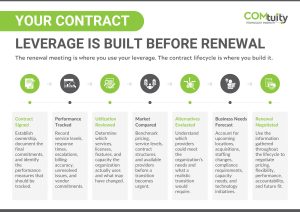
You do not need to be in a constant state of negotiation. You need a repeatable rhythm for maintaining the information that will support the next decision.
Throughout the Contract
Track performance, billing, service issues, usage, business changes, and vendor commitments.
Well Before Renewal
Review the agreement, confirm notice requirements, evaluate utilization, identify overlapping services, and discuss upcoming business needs.
While You Still Have Options
Benchmark the market, assess credible alternatives, determine transition requirements, and establish your preferred outcome.
During the Negotiation
Use the information you have gathered to negotiate pricing, terms, service levels, flexibility, and accountability.
After Signing
Document the final commitments, assign ownership, communicate changes, and begin tracking performance against the new agreement.
This turns IT contract renewal from a recurring emergency into a manageable business process.
Where COMtuity Fits In
Your internal team may know that earlier preparation would help, but maintaining performance records, tracking renewal dates, comparing providers, reviewing utilization, and coordinating vendor conversations all require time.
That is where COMtuity can support you.
We help you maintain visibility across your technology vendors, services, contracts, costs, and upcoming business requirements. We review what you are using, identify overlap and consolidation opportunities, compare available providers, and coordinate the conversations that strengthen your negotiating position.
Because our model is vendor-funded, our role is not to push a predetermined provider. It is to help you understand your options and find the structure that best supports how your business operates.
We also stay involved after the agreement is signed. Through ongoing oversight and the Strategic Technical Business Review, we help you track what is changing, where value may be slipping, and what should be addressed before the next renewal becomes urgent.
You remain in control of the decision. We help make sure you have the information, relationships, and time needed to make it confidently.

Do Not Wait for the Renewal Notice to Create Your Options
Your renewal date matters, but it should not determine your negotiating position.
The strongest technology contract negotiation begins months earlier through performance documentation, usage analysis, market awareness, credible alternatives, and a clear understanding of what your business will need next.
By the time the renewal proposal arrives, you should already know what is working, what needs to change, and which options are genuinely available.
If an important technology contract is approaching renewal, now is the time to determine whether you have enough information and flexibility to negotiate it well. Book a conversation with COMtuity, and we will help you review the agreement, understand the surrounding environment, and start building your options before the deadline starts making decisions for you.