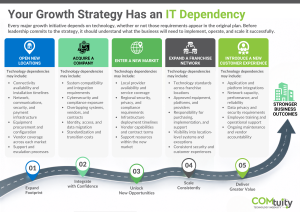
Every growth initiative has a technology requirement, even when it does not appear in the original business plan.
Opening a location, entering a market, acquiring a company, expanding a franchise, or introducing a new customer experience all depend on technology being ready at the right place, at the right time, and at the right cost.
Your technology team may be fully capable of supporting the plan, but bringing them in after the most important commitments have been made can limit their options.
The lease is signed. The acquisition date is announced. The opening timeline is established. The operating budget is approved. Only then does technology enter the conversation, when changing the plan has become difficult and expensive.

Translate Your Growth Strategy Into Technology Dependencies
Before you can evaluate whether a growth plan is ready, you need to translate the business initiative into the technology it will depend on.
Those dependencies will look different depending on what you are trying to accomplish. Opening locations brings questions about connectivity, equipment, installation timelines, and provider coverage. An acquisition introduces system compatibility, data migration, cybersecurity, and overlapping contracts. Entering a new market can create regional infrastructure, compliance, and support requirements. Expanding a franchise network depends on consistent standards and clear responsibilities across locations. A new customer experience may require stronger integrations, greater network capacity, and ongoing operational support.
The objective is not to solve every technical detail before leadership makes a decision. It is to identify what the initiative will depend on while there is still time to shape the budget, timeline, and approach.
Once those dependencies are visible, your leadership team can evaluate the plan through five practical questions.
1. What Technology Must Be Ready for This Initiative to Work?
Start by defining what your business will need on day one. That may include connectivity, communications, payment systems, security, employee access, cloud applications, system integrations, and vendor support.
These are not secondary implementation details. They are operating requirements that determine whether employees and customers can use the new location, company, or experience as intended.
Deloitte’s 2025 M&A Trends Survey found that access to technology ranked as one of the top two reasons companies wanted to acquire other businesses, tied with reaching new markets. Technology may be part of why you pursue growth in the first place, which makes it even more important to understand what will be required to realize that value.
Before approving the initiative, ask:
- What must be operational on launch day?
- Which systems, services, and vendors will the initiative depend on?
- What must connect with the technology you already use?
- Which capabilities are essential, and which can follow later?
- What would prevent employees or customers from using the new location, company, or experience as intended?
The goal is not to design every technical detail in the leadership meeting. It is to make the essential requirements visible before the business commits.

2. What Could Change the Timeline?
A growth timeline can look straightforward until it meets provider availability, installation schedules, landlord restrictions, permitting requirements, system integrations, and vendor dependencies.
Suppose you plan to open twelve stores next year. The dates work commercially, the leases are signed, and the launch schedule is announced. Then you learn that connectivity at three sites requires eight weeks of lead time. One landlord restricts your preferred cabling approach. Your payment platform needs an upgrade before it can support the new market.
None of those issues is unmanageable. The problem is discovering them after the dates have become commitments.
Before setting the timeline, determine:
- How long will connectivity, equipment, and installation take?
- Are your preferred providers available in each market?
- Do any buildings or landlords impose technical restrictions?
- Will systems need to be integrated, migrated, or reconfigured?
- Are permits, security reviews, or compliance approvals required?
- Which dependencies could delay everything that follows?
When you check the requirements before committing to a date, you can build a timeline that reflects what execution will actually require.
Technology should not enter early because it needs the power to delay the initiative. It should enter early enough to help you avoid promising a date the underlying dependencies cannot support.

3. What Will Implementation and Ongoing Support Actually Cost?
The price of launching a growth initiative is only part of its technology cost.
Your business case may also need to account for connectivity, equipment, licensing, implementation, integration, security, training, support, vendor management, contract commitments, upgrades, and eventual replacement.
Acquisitions introduce an additional layer. You may inherit overlapping systems, different providers, conflicting contract terms, and technologies that cannot immediately connect with your existing environment. Entering a new market can create different tax, privacy, security, or communications requirements. Opening locations quickly may force you to use short-term services that cost more than your normal standard.
These costs are manageable when they are visible. They become disruptive when they appear after the budget is fixed.
Before approving the investment, ask:
- What will it cost to implement the required technology?
- What will it cost to operate and support it after launch?
- Are there contracts, termination fees, or minimum commitments involved?
- Will the initiative duplicate technology you already own?
- Does the budget include integration, security, training, and support?
- What will need to be upgraded or replaced as the initiative scales?
This is where spending discipline matters. Under deadline pressure, it is tempting to solve each requirement independently. But rushed purchasing can create overlapping vendors, incompatible systems, and costs that continue long after launch.
When you decide the structure before the spend, your investment is more likely to support the full initiative instead of patching individual gaps as they appear.

4. Can Your Current Environment Support the Additional Scale?
Growth does not only add more users, locations, or transactions. It puts additional pressure on the systems, vendors, processes, and teams you already depend on.
A platform that works well across ten locations may not perform the same way across fifty. A support process built around one region may not translate into another time zone. An internal team that can coordinate a few vendors may become overwhelmed when an acquisition doubles the number of contracts and systems it must manage.
Before moving forward, assess whether your current environment can absorb the change.
Ask:
- Can your existing systems support the additional users, locations, data, and activity?
- Will the initiative introduce systems that do not communicate with what you already use?
- Can your vendors provide consistent service across the expanded footprint?
- Does your internal team have the capacity to support the initiative?
- Will security and compliance requirements change?
- Does the proposed approach support the next stage of growth, or only the immediate launch?
Acquisitions and rapid expansion can leave you with systems and teams that operate in separate silos. Identifying those gaps during planning gives you options. Finding them after launch leaves you solving them under pressure.
A repeatable location model can help when you are expanding an established footprint. But repeatability should not become an assumption. Each initiative still needs to be evaluated against market conditions, building requirements, operational needs, and the capabilities of your current environment.

5. Who Will Coordinate the Dependencies Through Launch?
Even a well-planned initiative can struggle when responsibility is divided among teams and vendors without someone coordinating the full picture.
Your connectivity provider manages its installation. Your security vendor handles its equipment. Your software provider manages its platform. Your internal team supports users. The landlord manages building access. Each party may perform its assigned work correctly while the overall initiative still falls behind.
Someone needs to connect those responsibilities to the business outcome.
Before approval, establish:
- Who owns technology readiness for the initiative?
- Who will coordinate internal teams and external vendors?
- Who tracks dependencies, deadlines, and unresolved decisions?
- Who confirms that systems work together before launch?
- Who handles escalation when one delay affects another?
- Who remains accountable after the opening, acquisition, or launch is complete?
This does not mean adding another approval layer. It means making sure someone can see across the work instead of expecting separate teams and vendors to coordinate themselves.

Is Your Growth Plan Ready for Approval?
Before committing to your next location, acquisition, market, franchise expansion, or customer experience, confirm that your leadership team can answer:
- What technology must be ready for this initiative to work?
- What infrastructure, integration, vendor, or regulatory constraints could affect the timeline?
- What will implementation and ongoing support actually cost?
- Can the current technology environment support the additional scale?
- Who will coordinate the teams, vendors, contracts, and dependencies through launch?
If those answers are still unclear, the initiative may contain important costs, constraints, or dependencies that are not yet reflected in the business case.
That does not necessarily mean the plan should stop. It means you still have an opportunity to strengthen it before your options narrow.

Where COMtuity Fits In
Your internal teams are already focused on supporting the business you operate today. When a major growth initiative appears, they may not have the time or visibility to evaluate every location, provider, contract, platform, and dependency before commitments are made.
That is the space COMtuity helps fill.
We work with your leadership and internal technology teams while the plan is still taking shape. We help identify what the initiative will require, uncover issues that could affect the timeline or budget, coordinate vendors, and connect individual technology decisions to the larger business outcome.
Because our model is vendor-funded, we have no reason to push one product over another. Our role is to help you identify the right structure for how your business actually operates and remain involved as the plan moves from approval into execution.
That is where IT strategy for business growth becomes operational. It is not a report handed to your leadership team after the decision has been made. It is a practical understanding of what growth will require before you commit your timeline, budget, and people to delivering it.
Before you approve the next growth move, make sure its technology requirements are part of the business case. Book a short conversation with our team, and we will help you identify the dependencies behind the plan while you still have room to shape it.