Budget season always brings pressure. In the last few weeks of the year, costs seem to carry even more weight than usual. IT issues you ignore in December do not disappear in January. Poor vendor management can follow you into a new budget cycle, raise your baseline spending, and make it harder to plan with accuracy. Telecom and connectivity costs are some of the most overlooked areas, yet they can contain a host of hidden waste.
While you might not see these issues in your day-to-day operations, the financial impact from telecom and IT services negligence can grow for years. To mitigate this, a year-end cost review is one of the most productive steps you can take.
A budget review doesn’t require new technology or complicated processes. It only requires a trusted partner with a structured method and a clear view of your agreements, services, and billing history.
This guide breaks down the areas that deserve your attention, why they matter now, and how an advisor like COMtuity can bring clarity to your telecom infrastructure and internet infrastructure without slowing down your internal teams.

How Telecom Waste Builds Over Time
Telecom bills are complex enough that extra charges are easy to overlook. These issues do not usually appear in a single month. Instead, they build across many months until the total cost impact becomes large enough to notice. By then, the waste has already added up.
Why December Is Crucial for Cost Review
December determines the financial foundation for the next year. If waste remains in your contracts at the end of the year, you start 2026 with inflated baseline costs.
You also lock inaccurate spending into your budget once a contract renews. With that, forecasting becomes harder. You may struggle to justify new investments because existing contracts consume too much of your operating budget year-over-year.
A careful review of your services will likely reveal several of the issues below.
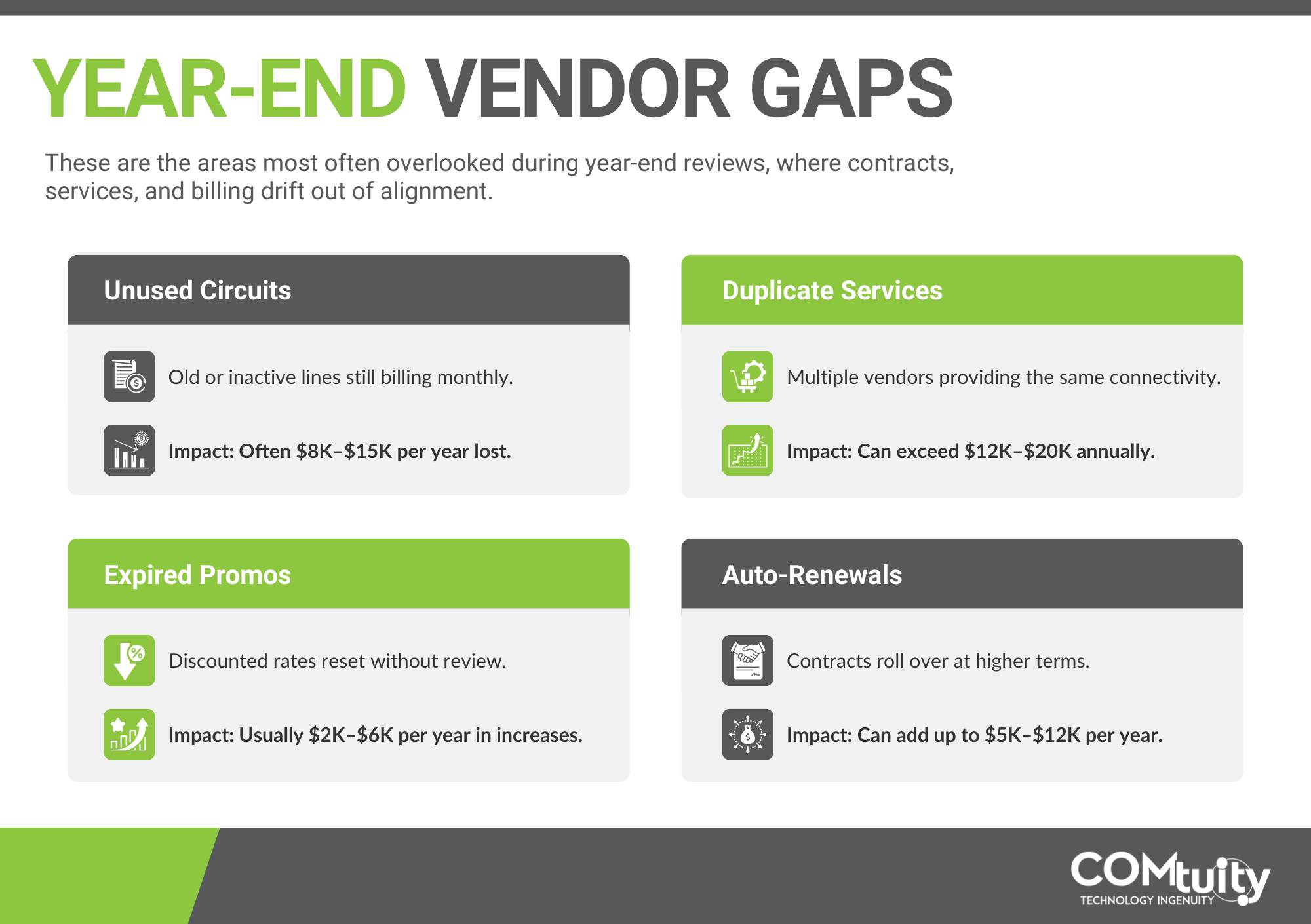
1. Unused or Inactive Circuits That Remain on Bills
Circuits often remain active even if a site no longer needs them. You might have upgraded to a new service, moved locations, or restructured your network. Providers do not remove old lines automatically. Bills continue until someone confirms a disconnect. These charges blend into regular billing, so they stay hidden for long periods.
Even one inactive circuit can add thousands of dollars a year to your spending. If this happens across multiple sites, the waste becomes significant.
2. Duplicate or Inherited Vendor Contracts
Acquisitions, relocations, and staff turnover make vendor activity hard to track. You might pay for two services that perform the same function. You might inherit contracts that no one remembers. You might renew agreements out of caution because the internal team is unsure what a service supports.
Duplicate contracts often appear after leadership changes or office moves. They leave you with unnecessary commitments that lock you into outdated pricing.
3. Outdated Bandwidth Tiers That No Longer Match Your Needs
Bandwidth needs shift with new applications, cloud tools, and workload patterns. Many companies pay for more speed than they use. Others pay for too little speed, which leads to performance problems. This imbalance usually stays hidden until someone reviews usage against actual service capacity.
Pricing also changes across the market. A tier that once cost more might now be available at lower prices. Without reviewing these changes, you risk paying more for outdated options.
4. Expired Promotional Pricing That Moves to Higher Rates
Providers offer promotional discounts for the first term. When the period ends, the rate increases. These increases often go unnoticed unless someone compares bills across time.
These rate shifts usually occur quietly. You might see a slight rise, but they often include “fees” or “adjustments” that make the change harder to notice.
5. Auto-Renewals That Increase Rates Without Review
Many telecom contracts include auto-renewals. When the term ends, the contract renews without a manual review. Providers often increase the base rate during renewal. If you miss the renewal window, you lose leverage. You get locked into another term at a higher cost.
This is one of the most avoidable sources of waste, yet it remains common because renewal tracking spans several departments.
6. Redundant Backup or Failover Services
Redundant circuits help maintain uptime, but many companies end up with more redundancy than they need. This happens when sites add backup connections without reviewing what already exists. The result is a larger bill with little performance gain.
A structured review helps you determine which redundancies matter and which only add excess cost.
7. Billing Inaccuracies or Double Charges
Billing errors appear more often than most teams expect. Providers add incorrect charges, bill for services that should be discontinued, or apply incorrect rates. Internal teams rarely have time to inspect billing line by line, so the errors continue for months.
A year-end review gives you time to trace these errors, request corrections, and secure credits.
8. Misaligned Contract Terms Across Multiple Locations
If each location runs on its own renewal timeline, you lose negotiation leverage. You also add more administrative work because you review agreements at different times throughout the year. Syncing these terms reduces surprises and gives you more control.
What Gets Lost Between Billing, Contracts, and Operations
Identifying the issue is usually the easy part. Where teams get stuck is turning that awareness into sustained action. IT costs remain difficult to manage because no single team has the bandwidth to own all the details. Here are the facts:
Internal Teams Rarely Have Time to Review Line Items
Year-end is often focused on closing out financials, supporting operations, and keeping projects moving. Detailed reviews require time and coordination that are not always available.
Complex Billing Makes It Hard to Understand What You Are Paying For
Carrier invoices are built around service codes and technical language, which makes it difficult to quickly connect charges back to specific circuits or business needs.
Vendor Communications Add More Confusion
Confirming inventory or pricing often involves back-and-forth with providers. Responses may be partial or delayed, which slows the review process.
Acquisitions and Turnover Hide Historic Vendor Decisions
As teams change or locations are added, older contracts and services often remain in place. Without a centralized record, it becomes harder to understand what is active and why.
This is where a tech advisory-led review adds value. A practical review creates a single, current view of the environment so decisions can be made with confidence.

What a Practical Year-End Review Covers
A structured review focuses on answering the questions that usually go unresolved during the year.
- Do you have a complete list of every circuit, internet service, line, and feature currently in place, including where they are and when they renew?
- Do your invoices reflect how those services are actually being used, or are you paying for outdated lines?
- Are contract terms and promotional rates aligned with your budget cycle, or set to change without notice?
- Are there duplicate services, oversized bandwidth tiers, or excess backup connections across multiple locations?
- Does your current pricing still reflect market conditions, and how do your contracts compare to available options in the COMtuity Marketplace?
Many companies want clean financial visibility but do not have the staff time to complete this type of audit. COMtuity provides the structure, detail, and vendor experience needed to complete a full review without burdening your teams.
We also handle vendor conversations, correction requests, term adjustments, savings negotiations, and more. This approach supports stronger vendor management and helps your internal teams stay focused on their priorities.
Position Your IT Environment for the Year Ahead
A year-end review may feel like a heavy task, but it protects your budget in practical and measurable ways. It brings hidden issues to the surface and gives you the chance to fix them before they shape your next year of spending.
These steps help you regain control of your telecom environment, reduce waste, and improve the accuracy of your financial planning. You start 2026 with a clean set of numbers, stronger vendor relationships, and a clearer view of your costs.
Contact us today for clear expert guidance and get a focused plan that strengthens your vendor management and supports your financial goals for the new year ahead.