Business owners invest in Secure Access Service Edge (SASE) for one reason: simplicity. It’s marketed as a “unified” bridge between networking and security.
But here is the expensive truth: A unified platform does not equal a unified strategy.
If your SASE agreement sits in a silo, disconnected from your SD-WAN contract, your firewall support, or your endpoint security, for example, you don’t have a system. You have a collection of expensive cloud subscriptions that don’t talk to each other.
At COMtuity, we view IT through the lens of The Trinity: the essential coordination between your NOC (Performance), your SOC (Security), and your SASE (Policy). If your licensing doesn’t support all three, you aren’t scaling—you’re just overpaying.
Reality Check: SASE and the “Parallel Silo” Problem
Most organizations “buy” SASE as a bundle from a legacy vendor. It sounds comprehensive until reality hits:
- You keep your old SD-WAN contract because it has two years left.
- You keep on-prem firewall support because you can’t “rip and replace” yet.
- You pay for a separate monitoring tool for compliance.
Suddenly, your new SASE license overlaps with tools you’re already paying for. You haven’t eliminated silos; you’ve created parallel silos.
It’s not just an architectural mess; it’s a financial one. When you peel back the layers of these parallel silos, three specific failures begin to drain your budget.
Why Your SASE Bundle is Failing You
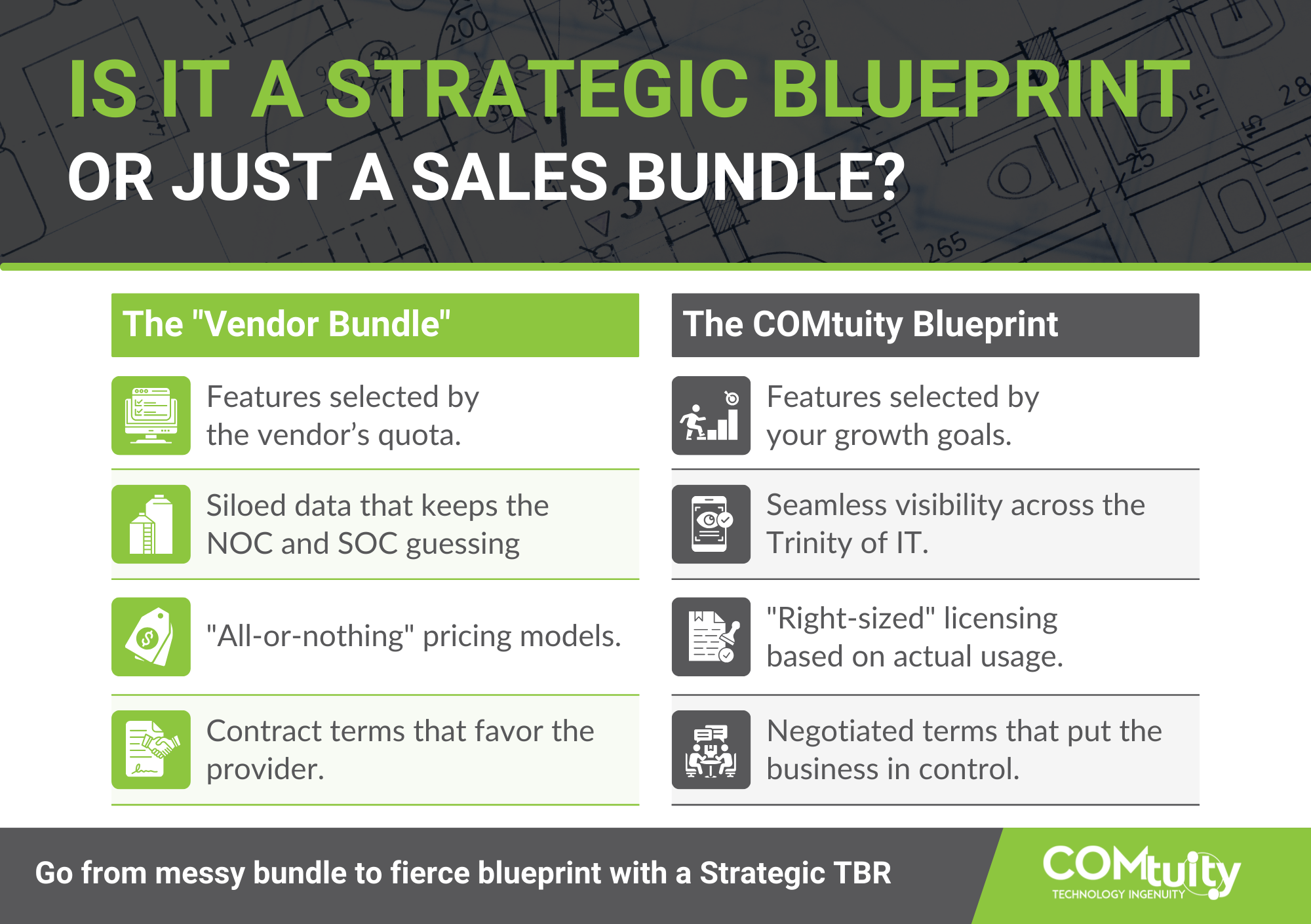
- The Financial Ghost: Feature Overlap Vendors love bundles because they hide “double charging.” You might be paying for firewall features in your SD-WAN, your SASE, and your data center. Without a structured review, you’re paying for three layers of the same protection—and you have zero leverage at renewal because you don’t know which one you actually need.
- The Visibility Gap The Trinity—NOC, SOC, and SASE—depends on shared data. If your SASE platform logs traffic but charges you “integration fees” or “API license upgrades” just to send that data to your SOC reporting tool, your team is flying blind. If you didn’t negotiate interoperability at the start, you’re trapped in a pay-to-play visibility model.
- The Expertise Gap (The “Shelfware” Risk) Bundles often include “Advanced” security features—like AI-driven threat hunting or CASB—that your internal team might not have the bandwidth to manage. If a feature is bundled but never configured, it’s not an asset; it’s shelfware. You are subsidizing the vendor’s R&D for a tool you aren’t actually using to protect your business.
Identifying these gaps is the first step, but closing them requires more than just a new vendor. At COMtuity, we solve this by aligning your existing contracts with a unified architecture.
The Path to Consolidation
Identifying these gaps is the first step, but closing them requires more than just a new vendor. It requires a shift toward rationalized, outcome-based agreements. SASE Vendor Consolidation isn’t about cutting essential tools; it’s about ensuring every dollar supports the Trinity.
A functional roadmap looks like this:
- Inventory the Stack: Map every contract tied to performance and security. Where do they start, and more importantly, where do they overlap?
- Identify the “Dead Weight”: Flag the features you are paying for but haven’t touched in six months.
- Define the Outcome: Stop negotiating for SKUs. Negotiate for a unified operating model, like a single reporting path that serves both the NOC and SOC.
This roadmap sounds straightforward, but the devil is in the details. Most organizations struggle to move from “inventory” to “execution” because they lack the time to challenge the vendor’s fine print. To turn this roadmap into actual savings, you need a different kind of seat at the table.
Why You Need a Fierce Negotiator
Your internal IT team is already underwater, managing day-to-day operations. They don’t have time to dissect 40-page vendor contracts or cross-reference entitlements.
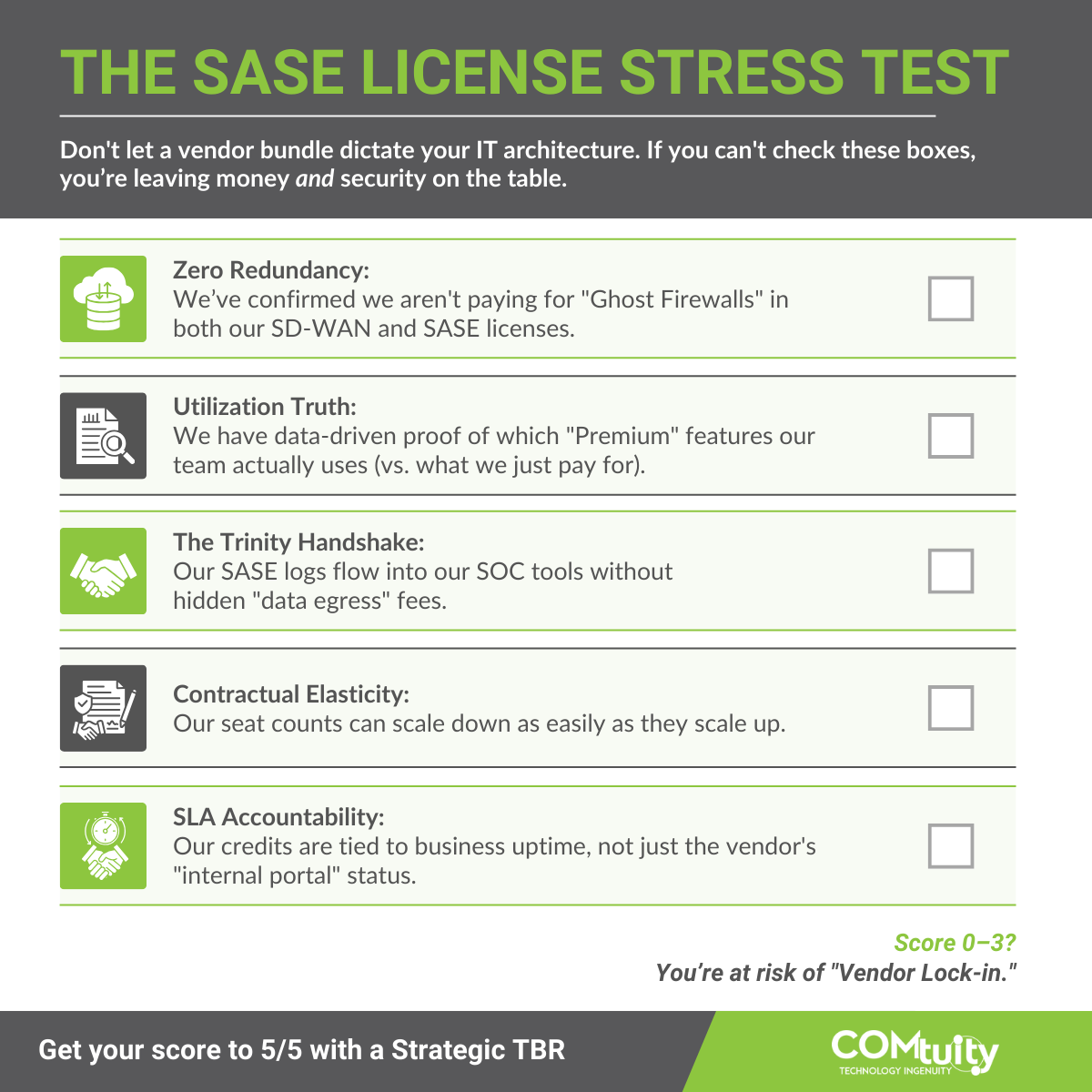
Vendors negotiate to protect their margins on bundles. COMtuity negotiates to protect your operating model. We ask the questions vendors hope you don’t:
- “Can this SASE license absorb our SD-WAN entitlements at renewal to prevent double-billing?”
- “Can we secure enterprise-wide visibility rights without upgrading every location to the highest tier?”
- “What is the specific roadmap to sunset legacy costs as the SASE platform scales?”
By shifting the focus from “buying tools” to “securing outcomes,” we strip away the bloat that traditional bundles rely on. But you can’t walk into a negotiation with gut feelings; you need hard data. That’s why our process always begins with a Strategic Technology Business Review (TBR).
Stop Guessing. Start Auditing.
The roadmap to a unified architecture is clear, but you can’t navigate it without a documented baseline. You cannot negotiate what you haven’t audited.
This is why we conduct a Strategic Technology Business Review (TBR). We look at your renewal timelines, your actual license utilization, and your business growth plans to ensure your “Trinity” actually works in harmony. For multi-location businesses, a TBR is the difference between a scalable architecture and a financial leak.
Ready to stop paying for “Unified” tools that live in silos? Schedule a Strategic TBR with COMtuity today and let’s turn your contract chaos into a streamlined, high-performance architecture.