Everyone talks about IT strategy.
We have been in plenty of rooms where a strategy is built, debated, refined, and ultimately approved. There is alignment across leadership, the priorities are clear, and it feels like the business has finally taken control of something that has been messy for a long time.
That moment matters, and it usually leads to real progress early on. For about six months, things move in the right direction. After that, something starts to feel off. Not broken, just less clear. Progress slows, decisions take more effort, and the strategy is still there, but it is no longer showing up the way it did early on.
We see this far more often than most organizations expect.
The Problem Is Not the Strategy
When things start to drift, the instinct is to question the plan itself. Was it too ambitious? Did something get missed? Does the approach need to be reworked?
In most cases, the answer is no. The strategy is usually sound. It reflects the right priorities and the right direction for the business. The issue is not what was decided, but what happens after that decision is made and the room moves on.
This is not a planning problem. It is an ownership problem. There is a gap between strategy being approved and strategy being actively maintained, and that gap is where things begin to come apart.
What Actually Happens After Approval
From a leadership perspective, once a strategy is approved, the expectation is straightforward. Teams execute, vendors align, and progress follows.
But in practice, it unfolds differently.
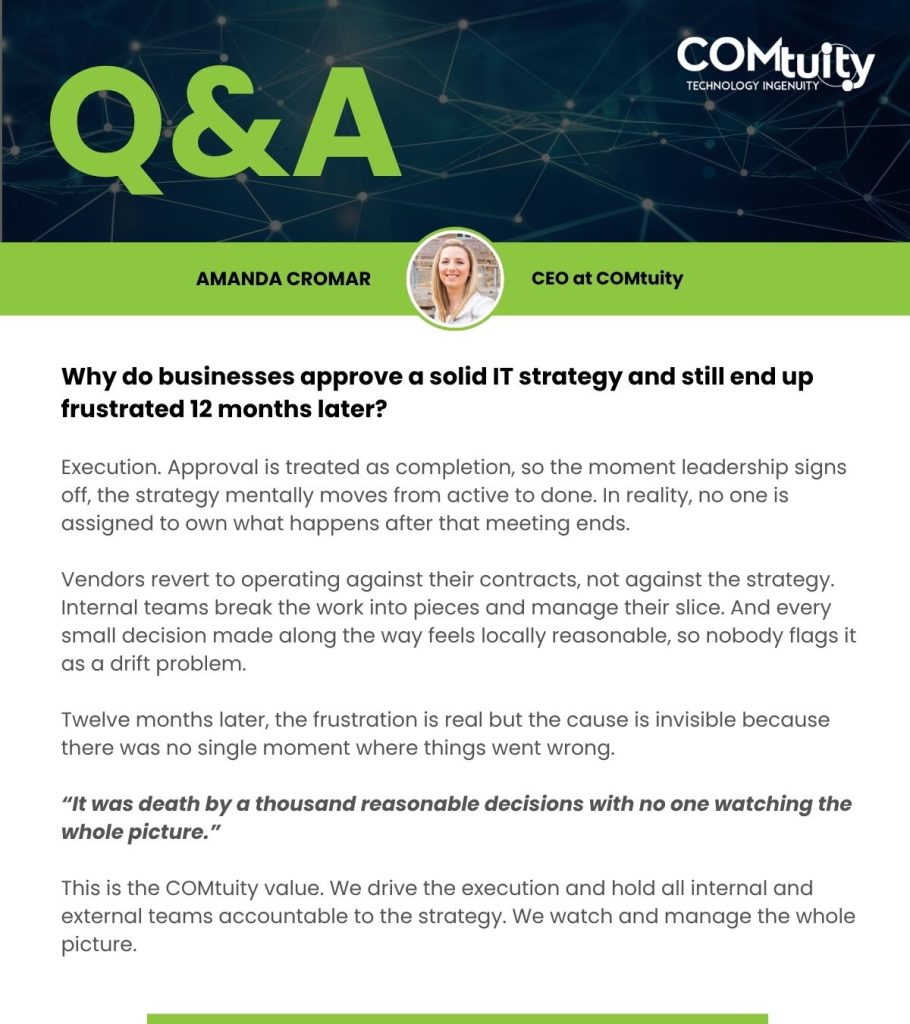
What we typically see is ownership becoming distributed, with the strategy broken into pieces that get handed off across teams and vendors, each focused on their own scope. At the same time, vendors continue operating the way they always have, aligned to contracts rather than to the broader strategy.
Small decisions start to drift. A recommendation here, a workaround there. None of it feels significant in isolation, which is why it usually goes unnoticed for longer than it should. Priorities shift as well.
We see this play out operationally all the time. A store calls in because the POS system cannot connect during lunch rush. The network vendor says it is a hardware issue. The hardware vendor points back to the network. Your internal team ends up stuck on a three-way troubleshooting call while the location runs transactions on a backup iPad.
Nobody involved believes they are stepping outside the strategy. But nobody is actively protecting the strategy either.
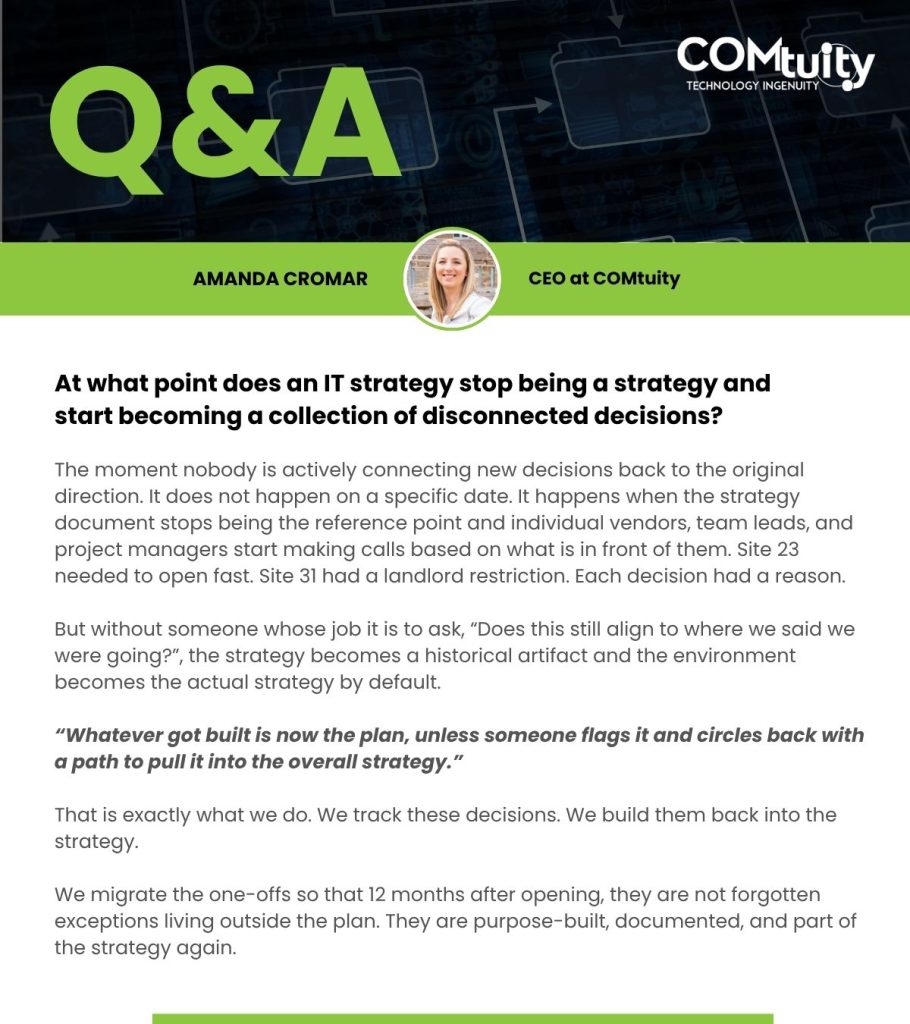
We see the same thing happen structurally over time. Every new site was supposed to follow the standard deployment model. Site 23 needed to open quickly, so the team used a different ISP that was immediately available. Site 31 had a landlord restriction, so a workaround was built. Site 38 inherited the previous tenant’s infrastructure because it was faster than pulling new cable.
Three years later, the IT director cannot confidently explain how locations beyond the original rollout are actually configured because every site now has its own story.
Six months in, everything still looks close enough from the outside. Twelve months in, it becomes harder to explain how the business moved from the original plan to where it is now.
Why This Is Harder to See Than It Should Be
There is no single moment where the strategy clearly fails.
Instead, it shows up in signals that are easy to rationalize. Projects take longer than expected, costs begin to move without a clear explanation, vendors become harder to coordinate, and the environment feels more complex than it should be.
From the outside, this looks like normal operational friction. From the inside, it often feels like something just needs more time.
In reality, the strategy is no longer being executed as designed. That distinction is easy to miss, but it changes how the problem needs to be addressed.
The Missing Layer: Ongoing Stewardship
This is the part that almost no organization formally assigns. Ownership of the strategy after it is approved.
Not ownership of individual projects or vendors, but ownership of the strategy itself. Someone needs to be responsible for keeping decisions aligned to the original direction, ensuring vendors stay coordinated, and stepping in when things begin to drift.
Without that layer, even a strong plan will gradually lose its shape.
What we see most often is that businesses invest heavily in getting the strategy right, then assume execution will naturally stay aligned over time. In practice, it rarely does. Over time, the strategy becomes something people reference rather than something that actively guides decisions. That is where the breakdown begins.
Where COMtuity Fits In
Most organizations are not lacking a strategy. They are lacking a layer that keeps it intact over time. That is where we step in.
We act as the execution layer that sits on top of your strategy, aligning vendors, contracts, and decisions to the direction that was originally set. In practice, that means identifying where things are starting to drift and helping the business correct course before those small changes turn into larger issues.
Because our model is vendor-funded, the focus stays on getting it right. There is no incentive to push a specific solution, and every recommendation is tied back to how your business actually operates.
In most engagements, clarity comes quickly once everything is mapped out. The challenge is rarely the technology itself. It is being able to see it all in one place and understand how it connects.
That shift alone changes how decisions get made.
What This Changes for Leadership
When the strategy is actively maintained, the experience changes in a meaningful way. Decisions become easier because they are anchored to a clear direction. Vendors operate with more coordination, and progress becomes more predictable because execution is not happening in isolation.
More importantly, there is a renewed level of confidence in the strategy itself. There is a clear connection between what was decided and what is actually happening in the environment.

The Real Failure Point
Most IT strategies do not fail because they were poorly designed. They fail because no one owns what happens after they are approved.
If the strategy is not actively maintained, it will drift over time in ways that are difficult to catch early. What starts as small, reasonable decisions eventually leads to a result that no longer reflects the original intent.
Most businesses think they have a strategy problem. What they actually have is an execution gap nobody was assigned to own.
If any of this reflects what you are seeing, we are happy to walk through your environment and give you a clear view of how your strategy is actually holding up.