
Most executives still view technology infrastructure the way it was viewed a decade ago. It sits in the background as something to maintain, optimize, and ideally reduce over time. That perspective was practical, and for a long time, it worked.
It does not hold up in today’s environment.
Infrastructure now plays a much more direct role in how organizations operate. It affects how quickly teams can move, how easily the business can scale, and how confidently leadership can make decisions. The companies gaining an advantage are not simply investing more in technology. They have a clearer understanding of how it all connects and what it is actually doing for the business.
That is where things tend to break down.
The Visibility Gap Behind Modern Infrastructure
Infrastructure rarely evolves as a coordinated system. It grows alongside the business, often one decision at a time. A new location brings in a different provider. A cloud initiative introduces another platform. A short-term need adds another vendor.
Individually, those decisions make sense. Over time, they start to drift.
What should function as a cohesive environment becomes harder to see as a whole. We see this play out regularly, especially in organizations that have scaled quickly or expanded across multiple locations.
Most leadership teams can tell you what they are spending in total. Fewer can explain how that spend is distributed, how systems interact, or where inefficiencies are hiding. That is where the visibility gap shows up.
According to Flexera’s State of the Cloud Report, over 70% of organizations cite managing cloud spend as their top challenge, which is less about cost itself and more about lack of visibility into how that spend is structured.
When the environment is not clearly understood, simple questions become harder to answer. Where are we overpaying? What is redundant? How quickly can we scale? What actually breaks if something fails?
At that point, the challenge is not technical. It is informational. Decisions slow down because the full picture is not there.
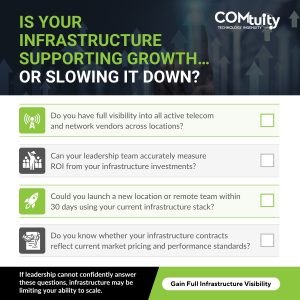
The Hidden Cost of Fragmentation
Fragmentation rarely presents itself as a single issue. It builds gradually across vendors, contracts, and systems until it starts to affect how the business operates.
When we step into these environments, the issue is rarely one big problem. It is a series of small, reasonable decisions that have never been pulled back together. A new provider solves a specific problem. A contract remains in place longer than expected. One location performs differently than another. None of these stand out on their own, which is why they tend to go unaddressed.
Over time, though, they begin to overlap. Services duplicate. Vendors operate without coordination. Deployments take longer than they should. The environment becomes more difficult to understand, even for the teams managing it.
That is when the cost becomes visible.
Gartner has estimated that organizations can waste up to 30% of their cloud and infrastructure spend due to underutilized or redundant resources. In most cases, that waste is not intentional. It is the byproduct of fragmented decision-making over time.
The impact is not just financial. More often, it shows up in how the business moves. Teams spend time working around systems instead of using them. Expansion takes more effort than expected. Decisions get delayed because the foundation is unclear.
Most organizations assume this is just part of growth. In reality, it usually points to something else. The infrastructure has evolved, but the strategy behind it has not kept pace.
Building a Unified Technology Stack
At some point, continuing to manage infrastructure piece by piece stops working. The shift happens when it is treated as a system instead.
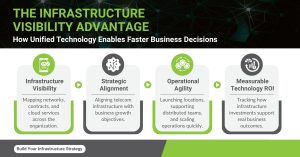
A unified technology stack aligns connectivity, infrastructure, and cloud platforms to how the business actually operates. Instead of layering on new components, the focus becomes coordination and structure.
This is usually the point where we help organizations step back and define what the infrastructure should look like before making further changes.
The immediate benefit is clarity. Leadership can see how technology supports different parts of the business without needing to piece it together across vendors and systems. That clarity carries into execution. Scaling becomes more predictable. Changes take less effort. Decisions are made with more confidence.
Cloud plays a central role here, but only when it is aligned to the operating model of the business. Otherwise, it tends to introduce more complexity than it removes.
The difference is not the technology itself. It is how intentionally it is put together.
Reducing Risk in Expansion and Growth
Expansion tends to expose whatever is not working beneath the surface.
Opening a new location or entering a new market requires coordination across vendors, connectivity, and systems. In a fragmented environment, that coordination becomes harder than it should be. Timelines stretch. Costs increase. Performance varies between sites.
We see this most often in multi-location organizations where each new rollout feels like starting from scratch. In many cases, every new site ends up being built slightly differently, which compounds the problem over time.
When infrastructure is aligned, that changes. New locations can follow a defined model instead of being rebuilt each time. Connectivity is consistent. Systems are accessible immediately. Vendors are already aligned to how the business operates.
We outlined what this looks like across real multi-site environments here:
https://comtuity.com/standardizing-it-across-multi-site-operations-a-strategic-guide/
At that point, expansion becomes more about execution than troubleshooting. The question shifts from whether the infrastructure can support growth to how quickly the organization wants to move.
Making Infrastructure Measurable
The longstanding frustration with technology infrastructure is that the costs are easy to track but the value is hard to see. That starts to change when you have visibility and alignment in place.
A unified infrastructure strategy lets you connect technology investments to outcomes that actually matter in the boardroom. Faster deployment of new locations reduces time to market. Improved uptime protects revenue continuity. A simplified vendor environment reduces administrative drag and frees your team to focus on work that moves the business forward.
IDC has found that organizations with well-aligned cloud and infrastructure strategies can improve operational efficiency by over 30%, which is where these improvements begin to show up beyond IT.
Where COMtuity Fits In
Most internal teams are focused on keeping things running. What they don’t always have is the space to step back and align infrastructure across providers, contracts, and platforms.
That’s where we step in.
We act as the relationship quarterback between your business and your vendors. We evaluate providers, align contracts, and make sure your infrastructure actually supports how your business operates.
Because we’re vendor-funded, our only incentive is to get the solution right. Not to push a specific provider.
We’ve been in the middle of these environments. We know where things break and what it takes to fix them. More importantly, we translate the complexity into something leadership can actually use to make decisions.
Turning Infrastructure Into a Competitive Advantage
The companies pulling ahead right now are not the ones with the most technology. They’re the ones with the most aligned technology.
When infrastructure is unified, expansion gets faster, risk goes down, and technology investments tie directly to business performance.
If you don’t have a clear view of how your infrastructure supports growth, you’re making decisions without a reliable baseline.
The good thing is that’s fixable, and it starts with getting a clear picture of what you actually have. If any of this is hitting close to home, happy to talk through what this could look like in your environment.