
IT leaders overseeing multi-location businesses face no shortage of complexity. Each site tends to develop its own way of doing things, with different hardware, software, vendors, and workflows, resulting in a tangled web of technology that’s difficult to manage and scale. When your operations are decentralized, so is your IT chaos.
The cumulative effect of this fragmentation shows up everywhere: delayed decisions, redundant systems, security gaps, and overworked internal teams. While every site may be functioning on its own, the lack of alignment can hold the entire organization back. According to the 2025 Gartner CIO and Technology Executive Survey, only 48% of digital initiatives meet or exceed their intended outcomes. That means more than half fall short often when projects span multiple sites, and misalignment is highest.
Multi-site IT standardization isn’t about forcing every location into a rigid mold. It’s about making consistent, strategic decisions that reduce complexity, speed up implementation, and give your IT team room to lead, not just react. Here’s a practical guide to solving the most common pain points and how a trusted advisor supports businesses in getting IT under control before Q3 adds even more pressure.
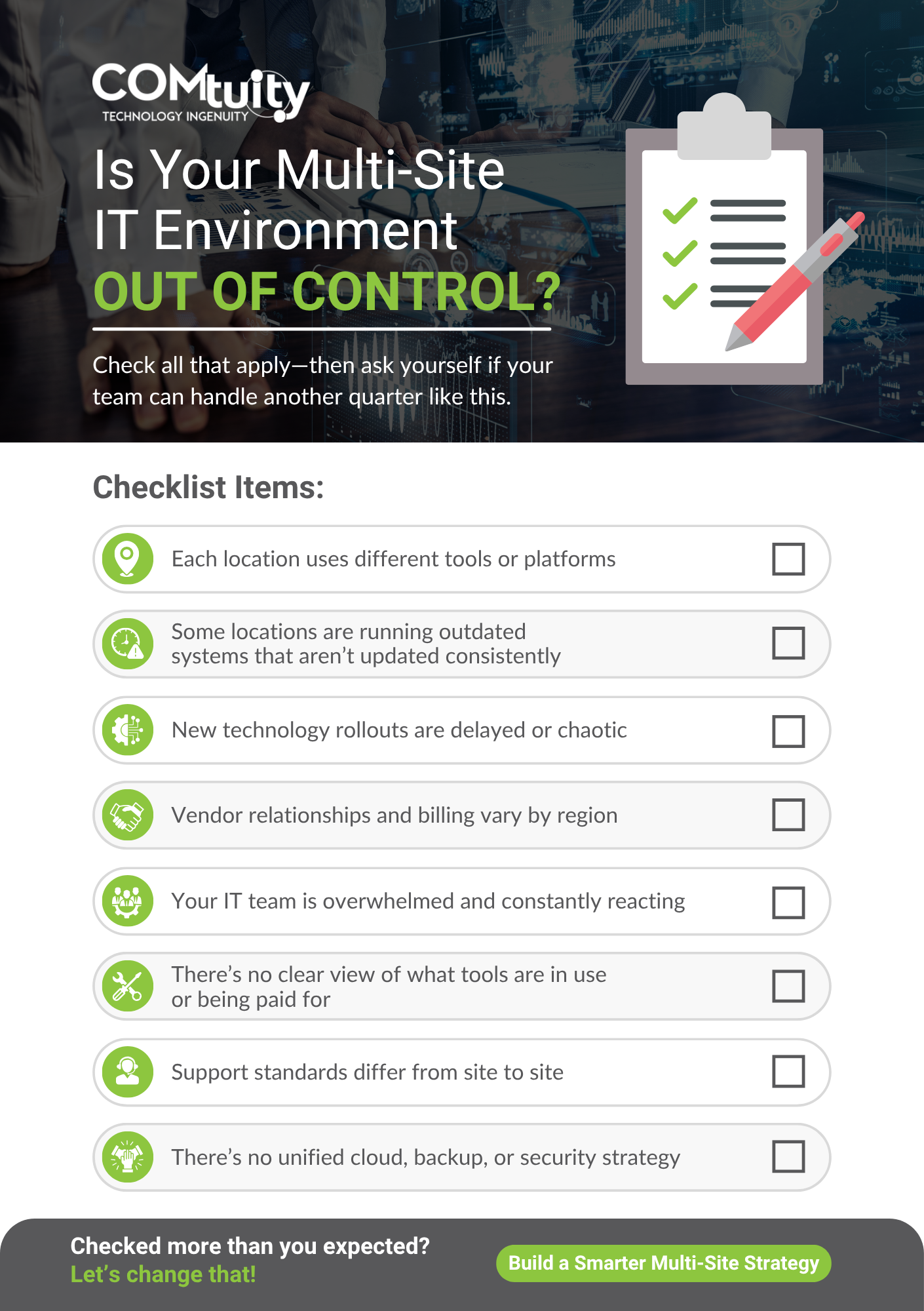
Disparate Systems, Disconnected Teams
When each location operates on its own set of tools and platforms, even simple collaboration becomes a challenge. Licensing costs multiply quickly, support issues take longer to resolve, and onboarding new hires turns into a time-consuming process. Teams often duplicate efforts or work around incompatible systems without realizing it. With no alignment across sites, operational gaps widen, and that’s where standardization matters.
- Unify Communication and Productivity Tools: Choose a common platform for email, chat, video calls, and document sharing to streamline workflows and reduce friction across teams. This also simplifies training and support for your internal IT staff.
- Standardize Device and Network Configurations: Consistent endpoint setups and network architectures reduce troubleshooting time and help maintain security across every site. It also allows you to scale more predictably as new locations come online.
- Establish Shared Cybersecurity Protocols: Implement uniform policies for access control, authentication, and data protection. This minimizes vulnerabilities and ensures your compliance efforts scale with your growth.
- Centralize Support Processes: Use a unified ticketing or help desk system so issues can be logged, tracked, and resolved consistently, regardless of location. Your IT team can respond faster and make smarter use of their time.
By aligning your core IT systems, you remove friction between teams and free up time for more strategic work. COMtuity helps you get there with clear assessments and vendor strategies built around how you operate, not how the market wants you to.
Vendor Sprawl and Procurement Delays
When each site handles its vendor relationships, procurement quickly becomes fragmented. You may have duplicate services, varying contract terms, and inconsistent pricing across locations. Approvals get delayed, support quality varies, and managing renewals turns into a full-time job. Streamlining vendor management isn’t just a financial decision. It’s a way to regain control and keep operations moving.
- Consolidate Vendors Across All Locations: Fewer vendors mean fewer points of failure and more predictable service levels. It also gives you leverage to negotiate better terms and pricing.
- Standardize Procurement Processes: Centralizing purchasing workflows creates consistency and speeds up decision-making. This reduces back-and-forth between teams and avoids miscommunication.
- Align Contract Life Cycles: Managing contract timelines through a unified system helps prevent lapsed services and last-minute renewals. It also improves budgeting and forecasting across your IT spend.
- Create a Unified Point of Contact: Having a single team coordinate vendor relationships eliminates confusion and reduces the burden on internal staff. You gain visibility and confidence without chasing updates from multiple sources.
When you streamline procurement, your team can act faster and more strategically. A trusted partner can simplify vendor ecosystems while protecting your flexibility and budget.

Burden on Internal IT Resources
When your team is constantly dealing with support tickets, patching mismatched systems, and reacting to issues across locations, strategic initiatives take a backseat. Instead of leading infrastructure planning or cybersecurity improvements, they’re stuck in a cycle of reactive work. Morale dips, burnout rises, and progress stalls. To shift out of firefighting mode, you need a support structure that absorbs operational noise and frees your team to focus on priorities.
- Delegate Routine Support and Maintenance: Offload common tasks like updates, patching, and basic troubleshooting so your IT team can focus on value-driven work. This helps reduce burnout and keeps your initiatives moving forward.
- Standardize Tools and Systems Across All Sites: With fewer variables to manage, your internal team can spend less time on fixes and more time on planning. It also streamlines training and onboarding.
- Use External Expertise for Complex Rollouts: Partnering with a team that understands your infrastructure speeds up implementation and minimizes internal disruption. It also ensures deployments follow a tested, repeatable framework.
- Maintain Clear Roles and Visibility: This builds trust and ensures alignment without added workload.
Shifting operational responsibility doesn’t mean giving up control. It means giving your team room to lead. We can support your internal staff with the right balance of expertise and execution. The result is less chaos and more progress, where it counts.
Delayed Rollouts Across Locations
Rolling out new technology across multiple sites shouldn’t require a custom plan for each location. But without consistency in systems, timelines stretch, errors increase, and teams spend more time adapting than deploying. Each site becomes a unique project, forcing your IT team to rebuild the wheel again and again. To avoid rollout fatigue and regain speed, you need a standardized approach that works at scale.
- Create a Repeatable Deployment Framework: Use a tested, site-agnostic playbook to ensure every rollout follows the same steps. This shortens timelines and reduces surprises.
- Align Infrastructure Standards Across Locations: When core systems and configurations are consistent, deployments become more predictable and supportable. It also reduces compatibility issues during installation.
- Combine Project Coordination and Communication: A unified rollout team eliminates conflicting instructions and keeps stakeholders on the same page. Clear timelines and expectations minimize downtime and confusion.
- Leverage National Implementation Partners: Working with a team that can scale deployments across geographies ensures consistency and continuity. It also reduces the strain on your internal team for large-scale rollouts.
Standardized rollouts move faster, cost less, and keep users more satisfied. COMtuity gives you the structure and support to scale without chaos. Whether you’re launching across five sites or fifty, they make execution consistent and repeatable.
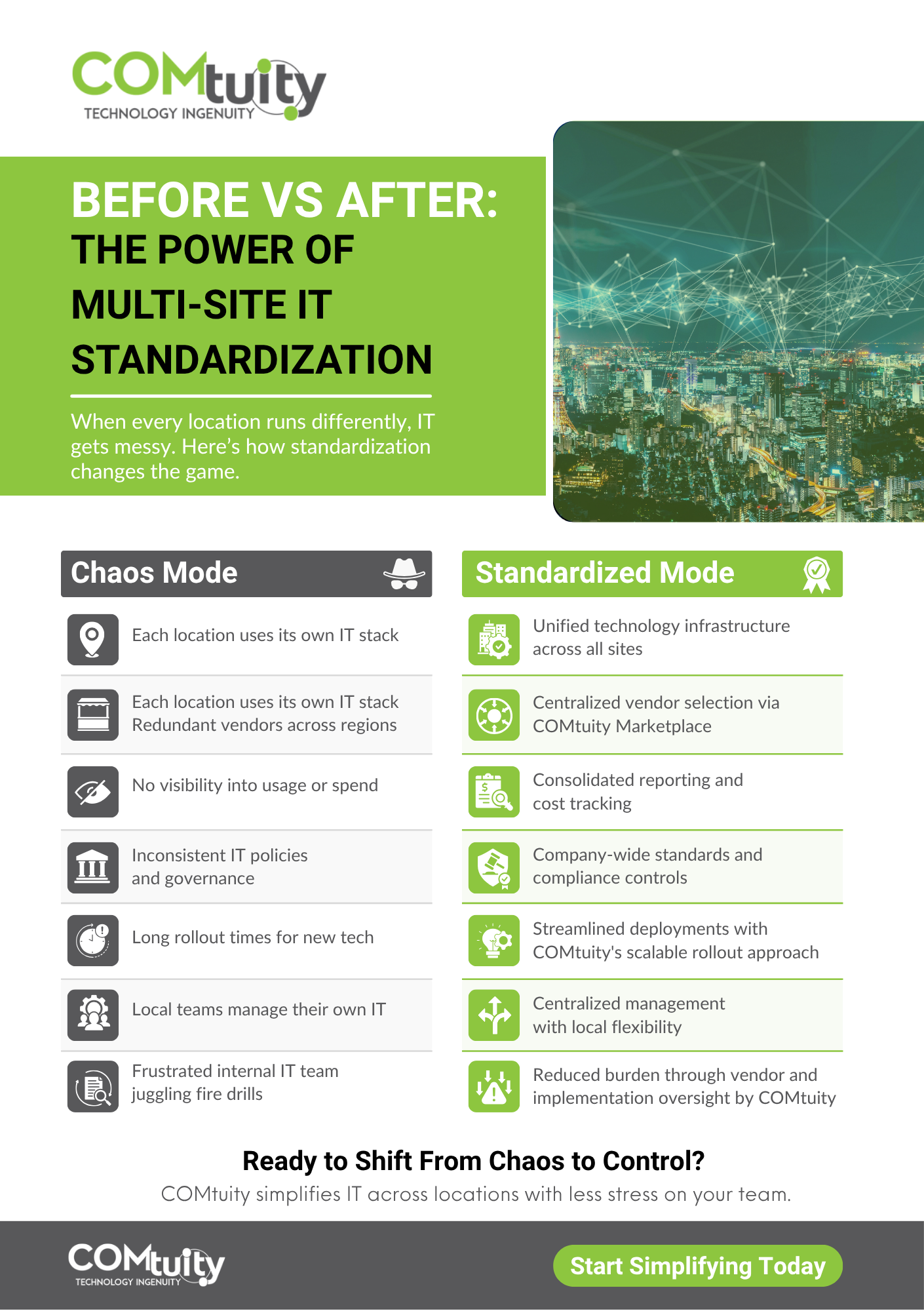
No Single Source of Truth
When data lives in disconnected systems across locations, IT leaders are forced to make decisions without the full picture. Tracking assets, managing contracts, and monitoring performance turns into a manual, error-prone process. Without real-time visibility, it’s easy to miss key updates, fall behind on renewals, or misallocate resources. To run efficiently at scale, you need one source of truth that’s accessible, accurate, and up to date.
- Merge Asset and Infrastructure Tracking: Maintain a single inventory of hardware, software, and services across all locations. This improves forecasting, budgeting, and lifecycle management.
- Unify Contract and Vendor Oversight: Store and manage all vendor agreements in one place to track renewals, SLAs, and performance. It reduces surprises and supports smarter negotiation.
- Implement Real-Time Reporting and Dashboards: Use live data to track system uptime, ticket volume, and other key metrics in one unified view. This makes it easier to identify issues before they escalate.
- Standardize Governance and Compliance Tracking: Apply consistent policies and audit trails across your environment. It simplifies regulatory reporting and reduces the risk of gaps during reviews.
When your data is centralized and reliable, you can act faster and with more confidence. COMtuity helps you build this kind of visibility into your operations without adding complexity. The result is better decision-making backed by clear, consistent information.
Why COMtuity is Built for Multi-Site Standardization
Supporting multi-location businesses isn’t just a side offering. It’s our core focus. COMtuity was built to help organizations that have outgrown their original IT setup or never had a cohesive strategy in place. We work with lean IT teams who need more bandwidth, better vendor coordination, and a structured plan to scale smartly, not just quickly.
We bring structure to fragmented environments and clarity to scattered vendor relationships. Our model combines the flexibility of a broker with the accountability of a full-lifecycle partner. That means one point of contact, fewer gaps, and solutions that stick.
Whether you’re a growing retail brand, a franchise group, or a restoration company scaling into new markets, we’ve done this before—and we’re built to do it well. We don’t just advise; we source, implement, support, and stay involved long after go-live. With access to 800+ carriers and technologies, we make vendor management feel less like a burden and more like an advantage.
Standardize IT Without the Stress
As summer ramps up and Q3 draws closer, your team doesn’t need another project that adds complexity. What you need is alignment, standardized tools, centralized processes, and a support structure that reduces effort instead of increasing it.
Multi-site IT standardization isn’t about forcing every location into the same box. It’s about creating a shared framework that reduces noise, simplifies execution, and gives your team space to lead with confidence.
COMtuity makes this not only possible, but practical. Our approach balances strategic oversight with operational execution so you can reduce IT chaos without losing control. Ready to simplify your stack and move faster? Schedule a complimentary consultation with our experts and start standardizing your IT today.